
From 2022
Supervised Work
Outreach Publications
24. G. H. Bilionis, T. A. S. Wanderley, G. E. M. Crisenza
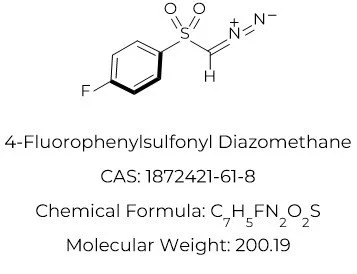
“4-Fluorophenylsulfonyl Diazomethane”
-
4-Fluorophenylsulfonyl diazomethane serves as a 1,3-dipole, or 1,3-dipole precursor, in cycloaddition reactions.Other arylsulfonyl-diazomethane analogues have been usedas Ru-carbene precursors in asymmetric cyclopropanationand S-alkylation protocols, as well as one-carbon homolo-gation reagents in formal C–C 𝜎-bond insertion processes.4-Fluorophenylsulfonyl diazomethane appears as an orangeoil and can be obtained in high purity by either Al2 O3 -mediated decarboxylation of 3,5,5-trimethylcyclohex-2-en-1-yl2-diazo-2-((4-fluorophenyl)sulfonyl)acetate, or deacetylationof 1-acetyl-p-fluorophenylsulfonyldiazomethane, under eitherAl2 O3 - or K2 CO3 -catalysis. Spectroscopic data (1 H, 13 C and19 F NMR spectra) for the title compound have been reported.4-Fluorophenylsulfonyl-diazomethane is unstable in acidicsolutions and reaction conditions. To prevent degradation, itshould be stored in the dark and at −20 ∘C. Differential scanningcalorimetry (DSC) studies indicate that this compound is highlyenergetic when heated above 40 ∘C. When handling it, avoidcontact/proximity to heat sources and switch off the heating bathof the rotary evaporator when concentrating a solution of thiscompound.
General Reactivity. 4-Fluorophenylsulfonyl diazomethaneprimarily reacts through its diazo-functionality and under-goes reactivity modes akin to those of other electron-deficientmono-substituted 𝛼-diazo-compounds (e.g., 𝛼-diazo-acetates, 𝛼-diazo-phosphonates). In comparison to its acetate or phosphonateanalogues, the sulphonyl moiety renders this compound moreversatile in terms of synthetic follow-up manipulation proce-dures. In fact, the sulfone functionality can be exploited as eitheran electron-withdrawing handle for 𝛼-substitution, an anionic andradical leaving group, a traceless methylene surrogate, and a rad-ical precursor upon single-electron transfer (SET) reduction.104-Fluorophenylsulfonyl diazomethane undergoes analogousreactions to any other arylsulfonyl diazomethane derivative.Thus, the reactivity of this whole class of compounds will bediscussed. Additionally, the presence of a fluorine substituent canbe helpful as a probe for NMR analysis.
23. R. Buscemi, P. Martínez-Balart, D. Bura, M. Díaz-Ruiz, J. Moreno-González, E. M. C. Pinheiro, J. J. Douglas, C. Trujillo, G. E. M. Crisenza
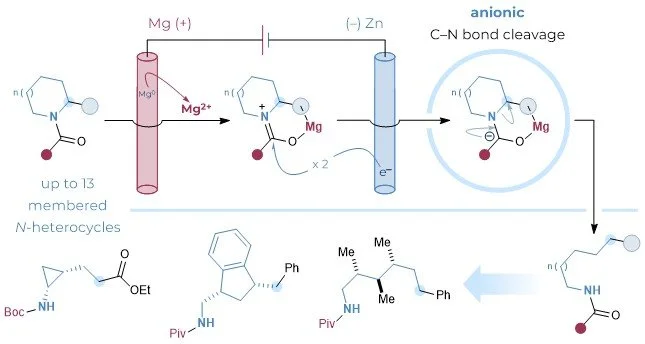
“Electroreductive Cleavage of C(sp3)−N Bonds in Saturated N‑Carbonyl Heterocycles”
-
Ring-opening C–N bond cleavage reactions provide an effective means to convert widespread, readily accessible chiral N-heterocycles into hard-to-attain stereodefined linear amines. Current strategies either rely on the strain-induced release of small aziridine and azetidine rings or, for larger ring systems, require highly electrophilic reagents, oxidative conditions, or preinstalled reactive functionalities to enable the ring-opening event. Recently, complementary radical strategies that exploit the reactivity of α-amino-ketyl radicals, formed upon single-electron transfer (SET) reduction of common N-carbonyl protecting groups, have emerged. Nevertheless, these methods facilitate the homolytic fragmentation only of up to 5-membered azacycles. In this study, we leveraged electroreductive conditions to switch the nature of the above C–N bond cleavage manifold from radical to ionic and enable the heterolytic ring-opening of a broad array of unstrained cyclic amines (comprising pyrrolidines, piperidines, azepines, azocanes, and N-macrocycles), protected as N-(thio)amides, carbamates, or ureas. Crucially, this electrochemically enabled reactivity switch grants complementary functional group compatibility and a broader ring size and N-carbonyl group scope. Computational and experimental studies indicate that electrochemical settings are crucial for generating the Mg(II)-Lewis acid catalyst, activating the N-carbonyl moiety while prompting the so-formed oxy-iminium ion intermediates to undergo two consecutive cathodic SET reductions, generating “umpoled” α-amino-α-oxy-carbanion species. These, via irreversible E1cB fragmentation of the adjacent C–N bond, lead to the desired ring-opened products. Our electrochemical procedure can be scaled up and miniaturized (enabling its application to high-throughput experimentation screening), and its synthetic utility has been demonstrated by accessing decorated stereodefined linear amides from stereochemically rich pyrrolidine and azepane derivatives.
22. T. A. S. Wanderley, G. E. M. Crisenza
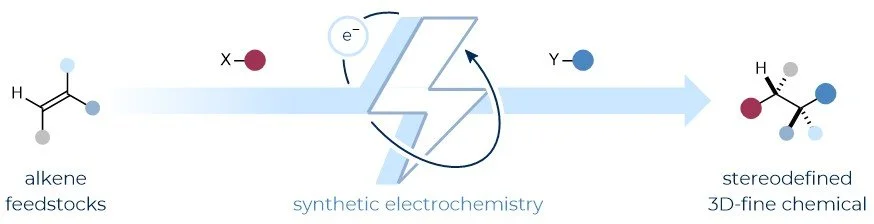
“The Electrosynthetic Toolkit for Stereoselective Alkene 1,2-Difunctionalization”
-
The asymmetric 1,2-difunctionalization of alkenes stands as one of the swiftest approaches to turn ubiquitous C(sp2)-feedstocks into C(sp3)-rich chiral fine chemicals. State-of-the-art transition metal-catalyzed protocols are efficient, selective, and robust; however, they are often limited in alkene scope, functional group tolerance, and are only applicable to specialized systems. Recently, the use of synthetic electrochemistry has provided effective solutions to these challenges, fostering the development of more general, selective, and sustainable variants. In this Synpacts, we will survey selected literature examples showcasing how electrosynthetic tools have been instrumental in enabling the design of innovative diastereo- and enantioselective alkene 1,2-difunctionalization reactions. These seminal contributions have inspired us to conceive a complementary “Sew & Cut” strategy—combining the generality and selectivity of pericyclic 1,3-dipolar cycloadditions with the complexity-generating ability of radical reactivity.
21. T. A. S. Wanderley, R. Buscemi, Ó. Conboy, B. Knight, G. E. M. Crisenza
“A General Alkene 1,2-syn-Cyano-Hydroxylation Procedure via Electrochemical Activation of Isoxazoline Cycloadducts”
J. Am. Chem. Soc. 2024, 146, 32848−32858
■ Highlighted in Nature Synthesis
■ Featured in Org. Chem. Highlights

-
Stereoselective alkene 1,2-difunctionalization is a privileged strategy to access three-dimensional C(sp3)-rich chiral molecules from readily available “flat” carbon feedstocks. State-of-the-art approaches exploit chiral transition metal-catalysts to enable high levels of regio- and stereocontrol. However, this is often achieved at the expense of a limited alkene scope and reduced generality. 1,3-Dipolar cycloadditions are routinely used to form heterocycles from alkenes with high levels of regioselectivity and stereospecificity. Nevertheless, methods for the ring-opening of cycloadducts to reveal synthetically useful functionalities require the use of hazardous reagents or forcing reaction conditions; thus limiting their synthetic applications. Herein, we describe the implementation of a practical, general and selective electrosynthetic strategy for olefin 1,2-syn-difunctionalization, which hinges on the design of novel reagents–consisting of a nitrile oxide 1,3-dipole precursor, equipped with a sulfonyl-handle. These can selectively difunctionalize alkenes via “click” 1,3-dipolar cycloadditions, and then facilitate the telescoped electrochemical single electron transfer activation of the ensuing isoxazoline intermediate. Cathodic reduction of the cycloadduct triggers a radical fragmentation pathway delivering sought-after stereodefined 1,2-syn-hydroxy nitrile derivatives. Our telescoped electrochemical procedure tolerates a wide range of functionalities, and─crucially─enables the difunctionalization of both electron-rich, electron-poor and unactivated olefins, with diverse degree of substitution; thus providing a robust, general and selective metal-free alternative to current alkene difunctionalization strategies. Capitalizing on these features, we employed our electrosynthetic method to enable the late-stage syn-hydroxy-cyanation of natural products and bioactive compounds, and streamline the de novo synthesis of pharmaceutical agents.